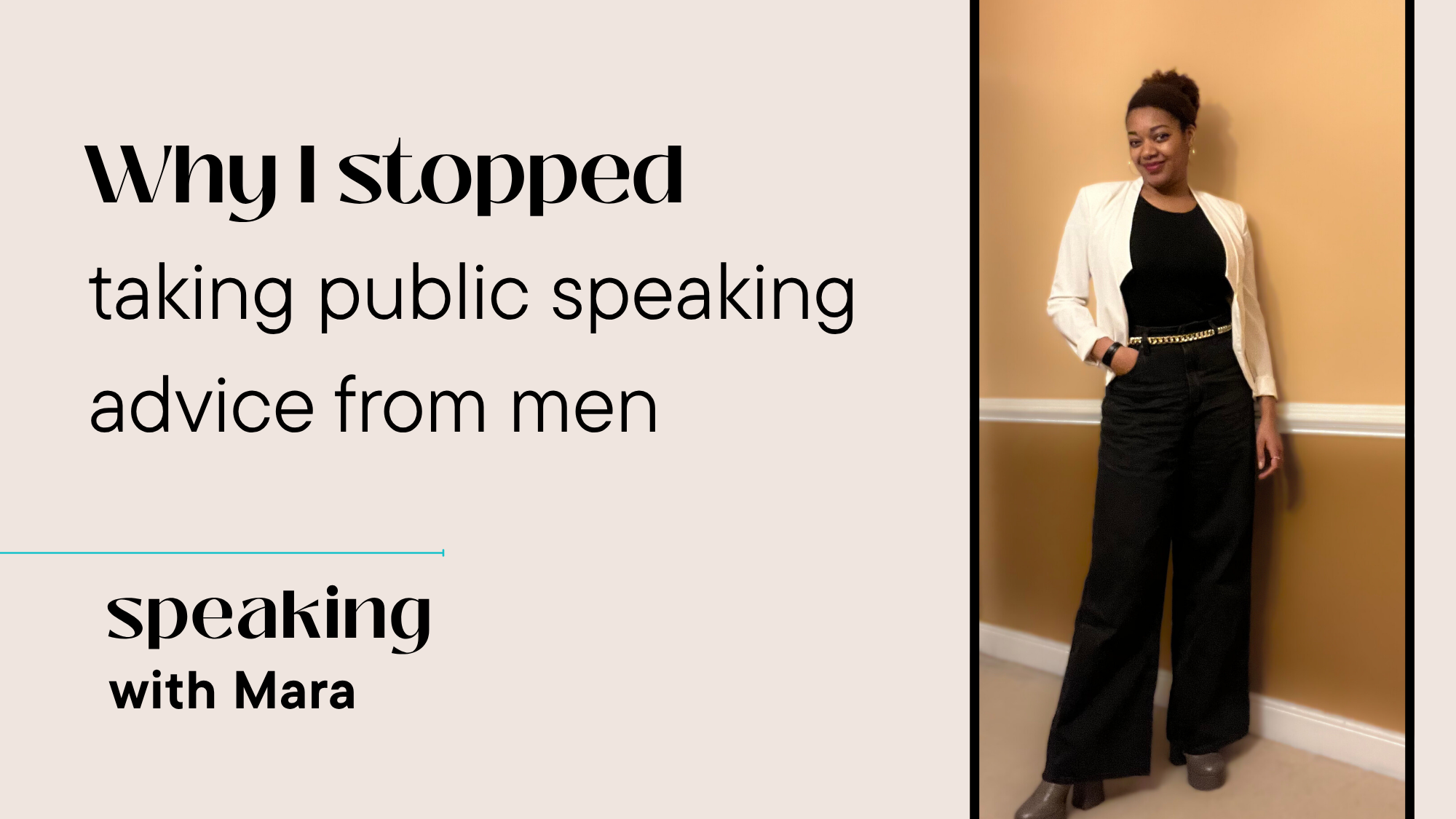
Why I stopped taking public speaking advice from men
When I began my personal journey with leveling up my communication at work, I read a number of the go-to recommendations. And they all contained at least one thing I benefited from seeing laid out on paper, but they didn’t quite land (with the exception of Never Split The Difference by Chris Voss, which I still recommend).
There seemed to be something missing. I could see how the information made sense, but it didn’t always feel accessible. I thought it could be because I’m Black or new to traditional business settings. But I actually think it’s men 😬
Hear me out.
Why I stopped acknowledging patriarchal public speaking advice
Most traditional public speaking advice is written by men for men. It doesn’t account for the ways in which women (and femme presenting people) get interrupted, belittled, and disregarded in the workplace. It didn’t teach me how to navigate around my “baby face” and get middle aged men to take me seriously. It didn’t account for the decades of conditioning to shrink myself, apologize for existing “too much,” and generally make myself palatable so no one could accuse me of being b*tchy.
So I decided to stop feeding the machine. Men telling other men how to be seen as more effective men in order to impress other men. Miss me with that. I began to only read communication and public speaking books by female authors and the nuance finally started to appear.
The tools and tips were more practical:
how to redirect a conversation when you see another woman get cut off or have her ideas stolen by a man who said it louder
how to stop physically shrinking yourself in public
how to counter inappropriate questions or remarks
AKA the stuff I actually needed to know.
I’ve found that this carries over to training as well. In having gone through communication training with male instructors through other jobs, I find the inability to address issues that uniquely face people perceived as women, nonetheless to offer suggestions on how to navigate them, irritating.
Most of the women I know have lived out the same reality - the advice just wasn’t made for us. And frankly, a lot of it feels like a piss-take (for those of you unfamiliar with British slang, this is something done to mock you and make you feel stupid).
Communication Piss-Takes I’m Done Taking
Piss-Take #1: If you put your hands in the wrong place people will stop listening to you and only be thinking about your crotch.
Let’s call them men, shall we? I’ve never once in my life seen someone clasp their hands in front of them and been distracted from what they were saying by the proximity to their nether region. That’s just men. And I’m sure not all men, but always a man.
The women I know could listen to my whole presentation if I gave it naked and follow up with notes and insightful questions. (Okay, so I haven’t tried this exact thing, but some big conversations happen in dressing rooms. We’ve gotten close enough!)
Piss-Take #2: You need to be making eye contact to appear confident.
It’s giving alpha male and I’m throwing up in my mouth. All of the smartest people I know think in a ✨direction✨ Staring thoughtfully off into the distance as they assemble their ideas and perspectives. I don’t think this makes them appear any less intelligent and it doesn’t take the power out of their points.
You need to be able to demonstrate that you’re listening but there are 102 ways to do that without staring straight down the barrel of your video cam or into the soul or your coworker. Landing some eye contact at the end of what you’re saying is more effective anyway.
Piss-Take #3: Tell yourself you’re not nervous, you’re excited.
I have never once been excited to be in a hostile environment and I’ve worked in many of them. I’ve had male supervisors give me nicknames behind my back, I’ve had male coworkers shoot down every idea I have without bringing their own. I’ve had executives yell at members of my team for not agreeing that their perspective is the right one.
None of those were exciting days at work, but that didn’t stop me from speaking up.
My nerves were riding shotgun the whole time. As I confronted my supervisor for underpaying me compared to my team. As I emailed that coworker and his manager about our working relationship. As I told an executive of a partner company that he could speak with my team respectfully or not at all.
The landscape is different for us and how you approach navigating it needs to be too.
How to learn presentation and communication skills that actually address being a woman at work
Good news! You’re in the right place already.
I created Director-Level Communication for and with women just like you. Women who knew they were capable of big, lofty achievements and high-powered roles, but who also knew that they needed to show up as leadership material well before they ever held a leadership title.
Using the principles in Director-Level Communication, we tackled how to give strong presentations and how to speak confidently in meetings. But we also worked through deprogramming some of that societal conditioning. We practiced speaking our value with confidence and embodying it in little ways that start to build big changes.
We extracted the passion, backbone, vision, and courage of real life women and infused it into their work personas - transferring the skills they already had into these challenging environments. And we saw them succeed. Not only in finding new roles that allowed them the growth they hungered for, but in changing the way they think about communication at work and how to make it work for them.
My main takeaway for today though, is that the conventional wisdom around public speaking wasn’t for us. We have an added set of challenges that shape the way we navigate the world, the way we think about communicating, and the hurdles we have to jump to be heard in the same way as the men around us. So find the women speaking about communication, round out your perspectives, and find advice that acknowledges you.